WELCOME!

WELCOME TO AKG!

FOR VIEWING SPACE WEATHER PRODUCTS CLICK HERE
AND THEN CLICK "ENTER"

-------------------------------OR-----------------------------------------
TO READ ARTICLES ON AKG BLOG OR SPACE WEATHER FORECASTS ( SEVERE SOLARWX) CLICK "ENTER" BELOW
ENTER

Monday, July 18, 2011

Sunspot number jumps to 101 .Solar Maximum likely to be early than expected May 2013


Above-
The SDO image of Sun showing numerous sunspots as of 18th July and the below image shows their nomenclature as per NOAA Space Weather Prediction Centre

TOP IMAGE-
The progress of Solar Cycle 23 and Forecast of Solar Cycle 24
Solar Influences Data Centre image

SEVERE SOLARWX
Akshay Deoras
Severe Weather Forecaster

The sunspot number ( A way of measuring the solar activity) has jumped to 101 as of 17th July 2011. The solar activity ( sunspot formation) was HIGHLY LOW for June 2011 when the average sunspot number ( monthly) was 37.0 ONLY. The overall activity was very low for June when NO such Major flares also were emitted.

However average of this month ( July) as forecasted by IPS Radio and Space Services is 53.1 however for June it was estimated to be 48.8 and factual was 37 only!

Average on monthly basis also shall reduce the July Sunspot no value to around 40-45 as per SEVERE SOLARWX

It now seems that Solar Activity is picking up on the sun however NO SUNSPOTS RIGHT NOW SHALL PRODUCE A BIG FLARE!

If readers remember the article where the datas indicated a possible Solar Maximum in May 2013

The latest arriving datas indicate the Peak Monthly Sunspot number to be 90.2 in the month of December 2012 and 10cm Radio Flux of 139.0

It means if the IPS Space and Radio Services are to be believed then the Solar Maximum shall happen EARLY than predicted in December 2012 instead of May 2013.

The Intensity of the Solar Cycle Maximum shall continue to be the same as forecasted in the above link.

Synopsis-
Solar Activity shall rise from now onwards with more sunspots forming this month than anytime previous year. The Solar Maximum shall be very less intensified than the 2001 Solar max.

Chances of event like the Maunder Minimum are still hovering but less as of July 2011!

Friday, July 8, 2011

Weather improving over Kennedy Space Center as the band of thunderstorms are expected to pass NW of KSC


Above-
The 300mb map shows the area of low pressure as designated by black counter of 972mb!

METD WEATHER & AKG
Akshay Deoras
Severe Weather Forecaster


The Pre-Launch activities are in full swing at the Kennedy Space Center,FL for the Historical Liftoff of Space Shuttle Atlantis on STS 135 amidst a disturbed weather at Launch pad 39A

The Hatch is closed and sealed with the astronauts boarded the shuttle

The Final Count of T-9 mins is now in progress and expected for a GO/NO GO decision after 45 mins from this post

Weather Synopsis and forecast--

An upper level low responsible for the increase in the moisture in the Launch Area ( Florida) is now over SE of Florida with the low level winds almost Southerly.

Attributed increased clouding with rains in spot shall be in the vicinity of the pad and posing a threat for the launch

Presence of Cumulus clouds shall be a primary concern.

The storms today are expected to brace North at 20-25mph originating mostly over the Gulf of Mexico

The present radar image shows " VERY MINIMAL" chance of an area of Thunderstorms around NW of Leesville shall be migrating SAFELY through NW of KSC.

*** THERE APPEARS NO CLOUDING ( CB type) SW of KSC which shall saturate and affect the launch.

*** WEATHER IS STILL BEING MONITORED AND IS LIKELY TO BE GIVEN A "GREEN"

METD WEATHER - " LAUNCH WEATHER UPGRADED TO YELLOW FROM RED"


Image credit-
NASA TV HD

Current Situation @ 1445UT

28C Overcast Weather with Clouds from 457m( Few) to 6096(Overcast)
No Rainfall has been reported till now.


Saturday, July 2, 2011

Waterspouts in Radar Images

| Create Your Badge


PENANG, NOVEMBER 15, 2010

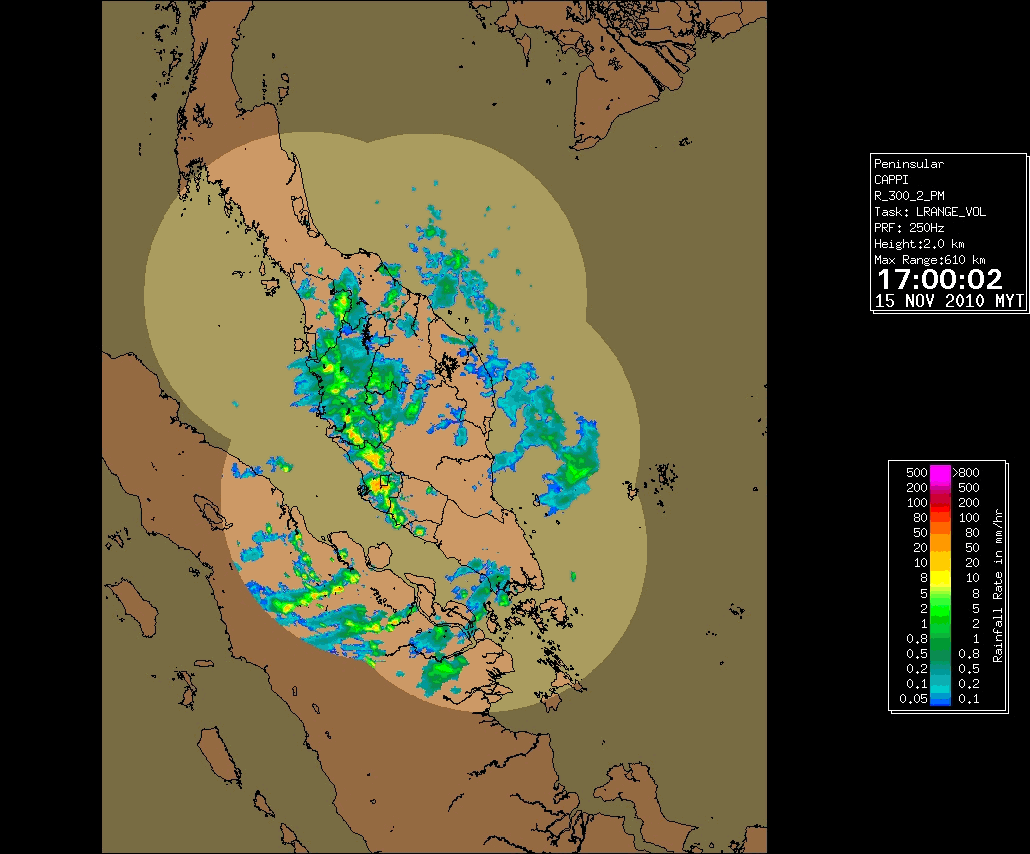
This is a radar image from Malaysia of November 15, 2010 waterspout in Penang. The watersprout happened at 6.33 pm MLT (or GMT+8). Malaysian Meteorological Agency likes to montage all radar data into one image (I regrets this thing), but this bureau (and also Malaysians) has akin of good documentation. The encircled part shows the forming of waterspout over Penang, marked with circular area of unusual high rainfall rate. Why should unusual? Because, while the other parts having high rainfall rate is located simply in one straight line, the marked part located so outside.


The lower image is the same radar image but taken at 17.00 MLT, showing no activity of thunderstorm in Penang to its north.


PERLIS, OCTOBER 28, 2010


Again, the waterspout in Perlis is not forming a prominent feature, and this one is hard to spot in radar. Because of having high precipitation aloft, the echo from the waterspout is quite obscured. Since waterspout is weaker than tornadoes, it rarely forms the shape of hook in radar images.


SETINDAN ISLAND NEAR MERSING, JUNE 17, 2011

This radar image shows a thunderstorm moving from west to east. When it meets with the South China Sea, it creates a waterspout.


Data provided by Malaysian meteorological radar archive and YouTube.


ANALYSIS OF RADAR IMAGE

Seeing the radar images above, I finally come to these hypotheses:

Waterspouts in tropical region is seemingly increased in duration when the wind from two opposite direction meets (see the first two radar images). This condition is fulfilled at March to June or September to November. In that times, the High pressure area of northern Pacific is moving from its previous position; In June, it located north of Philippine and west of Japan, while in December, it located more south; it can reach Moluccas and spawn high winds for eastern Indonesia. When it moving from previous position, the wind can pass northern Malaysia and meet the opposing wind from India, made the atmosphere there unstable. Explosive CAPE can be seen in Penang case, when a CAP above Penang and Kedah broke and creates a sudden thunderstorm in only one hour.

Thursday, June 16, 2011

15TH JUNE 2011 TOTAL LUNAR ECLIPSE PHOTOS


15TH JUNE 2011 LUNAR ECLIPSE PHOTOS

BY AKSHAY DEORAS,ALUTH FIAN

TOTAL LUNAR ECLIPSE PHOTOS AS TAKEN BY AKG FELLOW ALUTH FIAN FROM HIS HOMETOWN PAMULANG,INDONESIA

The much awaited TOTAL LUNAR ECLIPSE occurred on Wednesday.
However for much of India ( Central,Eastern,Western,North-Eastern) states the eclipse was hardly seen due to cloud cover and rains.

For me in Nagpur the weather troubled a lot.

The Telescope was deployed at 1020PM IST about 20 min later than expected due to low cloud ceiling. The Clouds were definitely troubling at an elevation of 609m.
For some time,cloud cover reduced and permitted for some hazy look as shown below!


THE ABOVE IMAGES WERE CAPTURED USING A CANON POWER SHOT SX 210 IS
14MP
RESOLUTION 1600 x 1200

AS THE CLOUD COVER FURTHER REDUCED, I TOOK OUT MY TELESCOPE
CELESTRON NEXT STAR 80 SLT

REFRACTOR TELESCOPE
APERTURE - 3.15"
FOCAL LENGTH - 35.5"
EYEPIECE - 30mm

ALL THE BELOW IMAGES WERE TAKEN USING A COMBINATION OF THE TELESCOPE AND THE CANNON CAMERA


ABOVE- MOON AND LOW LEVEL CLOUDS AT 10:30PM IST. IT WAS BEFORE THE PENUMBRAL ECLIPSE HAD BEGUN


ABOVE- IN THE P1( PENUMBRAL ECLIPSE 1) THE FULL MOON AS VIEWED WITHOUT CLOUD COVER


ABOVE- THE ONLY ECLIPSED IMAGE WHICH WAS AVAILABLE FROM NAGPUR AS CLOUDS AGAIN GATHERED AND THERE WERE RAINS TWICE.

YOU CAN SEE A LEFT-RIGHT INVERTED IMAGE DUE TO REFRACTED NATURE OF TELESCOPE


NOTE-
DISCLAIMER

ALL RIGHTS RESERVED WITH AKSHAY DEORAS OF THE IMAGES

THE IMAGES NOT TO BE USED WITHOUT CREDIT***

MEDIA PERSONS SHALL CONTACT ACCORDINGLY FOR REPRODUCE OF THE IMAGES OR PUBLIC SHARING/DISPLAY

Saturday, June 11, 2011

Saros Cycle, the Science of Predicting Eclipses

Alutsyah Luthfian | Create Your Badge

Huum...long time since my last writing about Japan Earthquake. Now I'm back with akin of astronomical writing! Hahaha it has been long since my last contact with astronomy. Let me count, umm it has been 1 year!
Now I will write about Saros Cycle. Saros cycle is one of eclipse cycle used by most astronomer, because of its famous pattern. Saros cycle is derived from 3 known variables: the synodic month, which is the time taken by moon from a new moon to another new moon (29.530589 days; this also being the base for Islamic Month), anomalistic month, the time take by moon from perigee to another perigee, it is 27.554550 days (perigee is the point where moon is in the closest position to the earth), and the draconic month, the time take by moon to move from one node to another node, it is about 27,212221 days. A node is a crossing made by the coincidence of lunar orbit and the ecliptic.
The Saros cycle is an eclipse cycle consisting 6585.322 days or 6585 days + 7 hours + 43 minutes + 40.8 seconds. That means, if at June 15, 2011 at 20:13 UT there will be total lunar eclipse with center of visibility at Indian Ocean, there should be another total lunar eclipse at June 25, 2029 at approximately 27:56 UT (or June 26, 2029 at approximately 03:56 UT) with the center of visibility 7 hours + 43 minutes + 40.8 seconds (or 115 degrees, 55 minutes, 12 seconds) farther west: South America region. That two lunar eclipses are in one Saros cycle. This Saros cycle is also applied for Solar eclipses, but its calculation for its precise hour and location are more difficult than that of lunar eclipse.
The more rarely used Exeligmos cycle comprises of 3 Saros cycles to compensate the .3 residue of the Saros. Its advantage is, the longitude of predicted lunar/solar eclipse will not differ much than the previous 54 years-ago eclipse. But until today, astronomers still prefer Saros to Exeligmos cycle.
A Saros serial is a serial of eclipses occur in consecutive Saros cycles, and each serial should be numbered. Saros serial have a start and an end, because the two nodes are moving westward. In each Saros cycle, the nodes move 0.4779 degrees in 2000 to 3000; that value is changing significantly each millenia. The start of a Saros cycle is marked by the presence of penumbral lunar eclipse or partial solar eclipse in the polar region. Each time the Saros cycle completed, the eclipse becomes darker, the totality becomes longer. Then the Saros serial reached its maxima; the node is directly overhead in equatorial region. After that, the Saros serial will run into its terminus; the totality becomes shorter, and it ended with penumbral lunar eclipse or partial solar eclipse, in the opposing Earth's pole.

The Calculation of Lunar Eclipse Based on Saros Cycle

Example: take an eclipse, say it is June 15, 2011 eclipse. From above explanation, we know that another eclipse occur with the same Saros serial will be at June 25, 2029 (from the addition of June 15, 2011 with 6585 days; you can do it in Microsoft Excel with ease).
Now we want to know the time:
The June 15, 2011 eclipse will be peaked at 20:12:36 UTC. The June 25, 2029 total lunar eclipse will be peaked at (20:12:36 + 7:43:40) = 27:55:40
nah, because there is no 27 o'clock, we should convert it to more rational form: 1 day + 03:55:40 UTC. So now the date and time of eclipse is June 25, 2029 + 1 day + 03:55:40 = June 26, 2029 at 03:55:40.This is only a rough estimation for the time, because we don't count the effect of tidal forces between sun, earth, and moon, the effect from nutation of moon, radius of earth and earth's atmospheric aberration. But remember that our calculation from Saros cycle alone is accurate to the hour.
For the location, each lunar eclipse separated by 1 Saros cycle will move
115 degrees, 55 minutes, 12 seconds farther west. This June 15, 2011 eclipse will be visible throughout East Asia, India, Australia. After one Saros cycle or at June 26, 2029, the central of visibility of total lunar eclipse will move to South America, Antarctica, West Africa. Then after one Saros cycle, or total lunar eclipse of July 7, 2047, the central of visibility will be Pacific Ocean and Australia, and so on.
For the kind of lunar eclipse that would be happen, we can use the standard regression of node every Saros cycle: 0,4779 degrees each cycle. Taking June 15, 2011 total lunar eclipse which node is located after the umbral center, and the umbra which is about 2000 km wide (and the revolution of earth made the time taken by umbra to cover the moon will be slightly longer), we can predict that total eclipses for this saros serial still persist well slight after 2100.
Beside the time, location, and kind of eclipse, we should also know the number of Saros serial of the eclipse. For July 15, 2011 total lunar eclipse, the number of Saros serial is 130, and so does with the July 26, 2029 eclipse and so on. 130 is an even number. Even number representing that the eclipse occurs at moon's ascending node. The last penumbral eclipse of this series will put the moon left of the earth's umbra, if our view to west. The opposite happen with odd Saros serial number (see figure below, the first eclipse of the odd Saros serial is located below the image, or left side of earth's shadow if our view is to west. Moon is at descending node).


The Calculation of Solar Eclipse

While the calculation of Lunar eclipse is easier because of we doesn't take much concern on location, the calculation of Solar eclipses is far more complicated, because, besides of determining the location, we should also determine how far is the moon from the earth. The distance of moon from the earth constitutes the kind of eclipse whether it is partial, hybrid, or annular. Much of this calculation has been taken by supercomputers. By means of Saros cycle, we could only determine the date, and rough time in UTC.

There are some patterns appear on solar eclipses:

1.) Two solar eclipses split by 354/355 days are separated by 10 saros series, example: The June 21, 2001 total solar eclipse of Saros 127 in Atlantic and South Africa and the June 10, 2002 Annular solar eclipse of Saros 147 in Mid-Pacific. But this pattern is limited: only 4 - 6 eclipses can match this pattern every 16-18 normal year - because this pattern is derived from Islamic calendar. In Islamic calendar, there are 12 cycles, based on the amount of Islamic months every year.
I give you the description of Islamic calendar eclipse pattern below.
I give you the 29-Muharram solar eclipse cycle. This means that an eclipse will occur always at 29 Muharram in a certain year. Consider if the cycle starts at Islamic year 1300 - this means, prior to 1300 there is (considered) no (recorded) solar eclipses at 29-Muharram. It will stop at about the Islamic year 1306 - this is the year when solar eclipses stopped to occur at 29-Muharram, and starts to occur at 29-Muharram again at 1300 + 22 years = Islamic year 1322. An Islamic calendar is consisting of 354/355 days, while the normal year is 365/366 days.
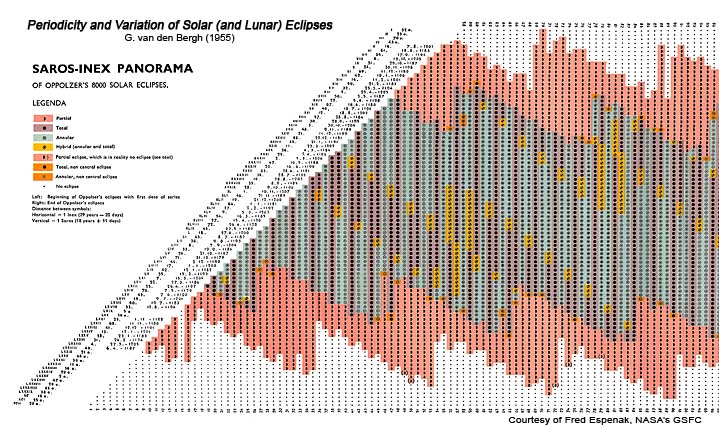
2.) Two solar eclipses split by 1 Inex or 10571.95 days ( about 29 years minus 20 days ) are in consecutive Saros series. Example: The June 21, 2001 total solar eclipse of Saros 127 in Atlantic and South Africa and June 01, 2030 annular solar eclipse in Russia with Saros number 128. This is the base theory for making the Saros-Inex Panorama, a diagram that consisting the date thousands of solar eclipses as appeared below.

3.) Normally, each move of 1 Saros cycle will put the center of solar eclipse more northwest than its previous location. This is due to difference between Synodical Saros cycle and Draconical Saros cycle as many as 0.036 day.
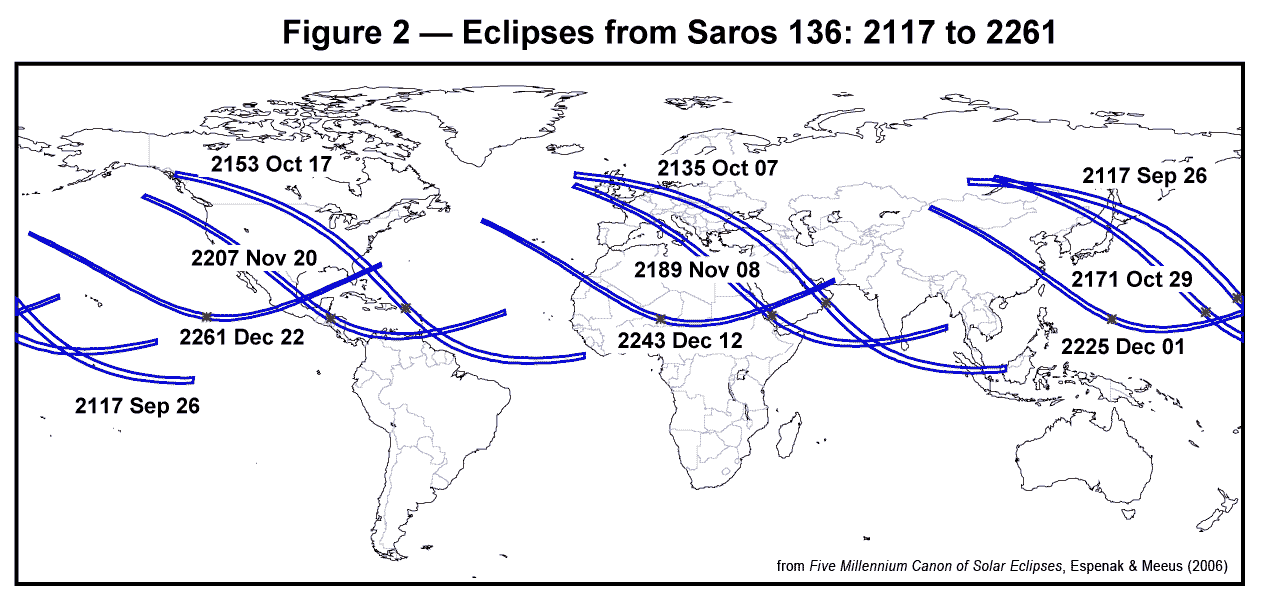
4.) But, the date when it fall can cause an anomaly for the point 3.) statement. This anomaly can cause the Saros serial "doesn't work as usual": The path of solar eclipse can be still located at equatorial region with total eclipse occur in a consecutive Saros cycle like this example:
The example above is an anomaly of Saros cycle because that nine Saros serial 136 solar eclipses are falling in coincidence with southern summer, so the northern part of earth is tilted away faster than the change of moon's inclination.

In solar eclipse, there are more variables constituting the type, place and specific hour (not date), since it affects only a small area and very short period of time. The variables are gamma (the distance of the apex of moon's shadow to the center of earth divided by the radius of earth), delta T (the difference between UTC and Terrestrial time), and Besseliant Elements (an arranged values to calculate and predict the local circumstances of eclipse for an observer on Earth).

SCIENCE OF ECLIPSE ( LUNAR) AND THE JUNE 15 2011 TOTAL LUNAR ECLIPSE

ABOVE-
THE SIMULATION SHOWING HOW THE TOTAL LUNAR ECLIPSE WILL APPEAR OVER NAGPUR,INDIA

TIMES DISPLAYED ARE LOCAL = GMT + 5.30HRS


ABOVE- PHASES OF MOON


ONLINE LIVE ECLIPSE ( DURING THE EVENT)

The Central Lunar Eclipse will be shown live through WEBCAST -
By Sky Watchers Association of North Bengal(SWAN) Siliguri, West Bengal
http://www.skywatchersindia.com/
or
http://www.livestream.com/swansiliguri
By Eclipse Chaser Athaenium New Delhi
http://www.ustream.tv/user/eclipsechasers
By Astronation.net at http://www.astronation.net/webcam/10022/342/mondfinsternis-juni-2011.html

The decade's first lunar eclipse as well as the first total lunar eclipse of this year & decade shall take place on Wed 15th June 2011

The Moon shall turn Coppery Red as the scattered light due to Rayleigh's effect strikes the moon and gives the glow!

Science of Eclipse-

Like known by all an Eclipse is an obscuring of light from any celestial object as another cellestial object passes in between the source and observer or the light from the source is blocked by an object leading to visible shadow of that object on another.
Lunar Eclipse is annually occurring phenomena.

Orbital Configuration of the Moon

Since Earth-Moon form a Planet-Moon system, both of them rotate about their centre of mass referred as Barycenter. This barycentre is about 4700km from Earth's centre which

is about 3/4th of Earth's Orbit ( Apx 6400km)

( Right- The Earth as centre and the moon revolving about centre of mass shown as PLUS sign)

The orbit of the moon around the Earth is elliptic. Moon's orbit around the earth makes an angle of 5 Degree 14 mins with earth's celestial equator as well as the ecliptic ( App
arent path of Sun in Earth's sky as viewed from earth or the path traced by earth as seen from the sun)

Its like when you consider a clock let the minute hand pointing from 9 to 3 be the so another minute hand pointing from 2-7 is the moon's orbit around the earth but in the real three dimension of space


Thus moon's orbit crosses the ecliptic two times during one orbit referred as nodes( Explained below)

Moon completes a revolution around the Earth in 27.231 days
( IMG COURTESY- ARVIND PARANJPYE)
Nodes of moon's orbit around the Earth-
Nodes are the two positions in the orbit of moon around the earth where the moon's

orbit intersects the ecliptic. Thus for earth's shadow to be casted on moon or moon blocking the solar disc, the moon must be at a common plane or have co-planar orbits.

But it is not necessary that every approximate 15 days when the moon reaches the node ( Descending Node- When the moon is declining from the ecliptic axis MOVING NORTH TO
SOUTH and

Ascending node- When the moon is inclining the ecliptic axis MOVING SOUTH TO NORTH) eclipse will take place as its not necessary that the relative angular separation of sun and moon is 180 Deg ( Case of Lunar Eclipse) when the moon passes from non sun facing side of the earth or 0 Degree ( Case of Solar Eclipse) when moon is in between earth and sun


For any eclipse, Solar or Lunar- New Moon or Full Moon is required respectively. ( Node and Ecliptic)

Why is this??

When there is New Moon, the moon is in between earth and sun ( Not necessary that its always in a liner path) but remains in inclined or declined position depending on its motion.

During full moon, the moon is in opposite direction that is at the non sun facing side of the earth.

Thus as per definitions of solar and lunar eclipse relating to position of Moon with respect to earth the above condition is satisfied.

During every orbit, moon has the same cellestial longitude required for eclipse ( In 29.53 days) but the celestial latitude is not proper and the concept of Ecliptic limit is introduced

Ecliptic Limit-
It is that minimum angle between the position of moon and the node of the moon's orbit required for an eclipse to occur

Its of two type-
Major Ecliptic Limit

A Lunar Eclipse MAY occur when the moon is at
11° 38' ( Celestial Latitude) of a Node, and a Solar Eclipse MAY occur if there is a New Moon within 17° 25' of a Node.

For a Solar Eclipse to occur, the Moon's Celestial Latitude cannot exceed 1° 27', and must be less than 58' for the Solar Eclipse to be Total or Annular.


  • Major Ecliptic Orbit A Lunar Eclipse MUST occur if there is a Full Moon within 9° 39' (Celestial Longitude), of a Node, and a Solar Eclipse MUST occur if there is a New Moon within 15° 23' of a Node.

  • If a New or Full Moon occurs within 5° of a Node, the Eclipse will be Total or Annular.

Additionally:

  • For a Lunar Eclipse to occur, the Moon's Celestial Latitude at Full Moon cannot exceed about 55', and for that Lunar Eclipse to be Total, Celestial Latitude cannot exceed 26'

*** Also
THE MOST IMPORTANT OF ALL - FOR ECLIPSE A PERFECT LINEAR ALIGNMENT,THE SUN-MOON-EARTH NEEDS TO BE PERFECTLY ALIGNED AND THIS CAN HAPPEN ONLY WHEN THE MOON IS AT ONE OF THE NODES AND THE SUN ALSO AT ONE OF THE NODES OR WITHIN THE ECLIPTIC LIMIT
***

An Interesting animation here

Thus for any eclipse to happen,above condition mentioned be satisfied.


June 15 2011 Total Lunar Eclipse-


The June 15 2011 Lunar Eclipse shall be the first lunar eclipse of the year and THE FIRST ECLIPSE SINCE 2000 WHERE THE MOON WILL PASS THROUGH THE CENTRAL PORTION OF EARTH'S SHADOW ( UMBRA)

THE PREVIOUS LUNAR ECLIPSES ( NOT OF THE 2000 LUNAR ECLIPSE),MOON PASSED NOT THROUGH EXACT CENTRAL UMBRA BUT SLIGHTLY ABOVE CENTRAL UMBRAL REGION.

THE ECLIPSE BEGINS WITH THE FIRST CONTACT ( P1)

AT 17:23:05 UT ON WED,15TH JUNE 2011


Visibility-

Europe, Africa, Asia, Australia, New Zealand, southern South America and eastern South America. Places that won’t see the eclipse at all include Hawaii, North America, northwestern South America, Greenland, Iceland and the Arctic.

WITH THE SUN SETTING OVER EUROPE, THE CONTINENT SHALL WITNESS THE ECLIPSE AFTER SUN SETS TILL AROUND MID NIGHT.

EUROPE SHALL SEE A UMBRAL ECLIPSE MISSING THE INITIAL STAGES OF ECLIPSE AS THE MOON WILL BE BELOW THE HORIZON. THUS THE MOON WILL RISE IN ECLIPSE ONLY IN EUROPE

*** TOTALITY SHALL NOT BE SEEN BY NORTHERN SCOTLAND,SCANDINAVIA***

EAST ASIA,EAST AUSTRALIA AND NEW ZEALAND WILL MISS LAST PHASES OF ECLIPSE AS THE MOON SETS IN ECLIPSE ONLY

TIMINGS- ( UTC)

P1 - 17:23:05
U1- 18:22:37
U2- 19:22:11

GREATEST- 20:12:37

U3 - 21:03:22
U4 - 22:02:35
P4 - 23:02:15


TIMING IN INDIAN STANDARD TIME ( IST= GMT+5.30HRS)

2011stagePhasetime (IST)

Jun 15

1

Moon enters penumbra

22:52:52

Jun 15

2

Moon enters umbra

23:52:24

Jun 16

3

Start of totality

00:51:57

Jun 16

4

Maximum eclipse

01:42:24

Jun 16

5

End of totality

02:32:50

Jun 16

6

Moon leaves umbra

03:32:22

Jun 16

7

Moon leaves penumbra

04:32:02


CHARACTERISTICS-
*** DARKEST ECLIPSE SINCE JULY 16 2000 LUNAR ECLIPSE AS THIS TIME MOON'S CENTRE PASSES THROUGH 5.3 ARCMINUTES OF SHADOW AXIS***

*** NEXT DARKER ECLIPSE ON JULY 27 2018***

*** EARTH'S SHADOW FALLS IN CONSTELLATION OPHIUCHUS NORTH OF SCORPIUS***

B9.5Ve spectral class star BSC 51 OPH TO LIE IN THE UMBRA OF THE EARTH'S SHADOW
RIGHT-
THE MOON AS THE CENTRAL COPPERY RED OBJECT SURROUNDED BY EARTH'S SHADOW AND BSC 51 OPH TO ITS LOWER RIGHT AS TO BE SEEN FROM NAGPUR,INDIA DURING PEAK ECLIPSE


SAROS- 130
GAMMA- 0.090
PENUMBRA ( MAGNITUDE) - 2.712
UMBRA ( MAGNITUDE) 1.705

TOTALITY- 100 MINS AND 52 SECONDS


FOR INDIA-

ECLIPSE DURATION - 22:52 ( 15TH JUNE) TO 0432 ( 16TH JUNE) IST
MAXIMUM ECLIPSE AT 0142( 16TH JUNE) IST


REFERENCES AND COURTESY-

1] ARVIND PARANJPYE FOR TABULAR FORM AND IMAGE
http://www.iucaa.ernet.in/~scipop/Eclipses/Luna15jun11/lunar_eclipse_1106.htm


2] WIKIPEDIA
3] ECLIPSE @ NASA
4] CARTES DU CIEL SOFTWARE


Wednesday, June 8, 2011

Sunspot region 1126-1127 produces a M2 class Solar Flare


SEVERE SOLARWX
Akshay Deoras
Severe Weather Forecaster

The anticipated sunspot region 1126-1127 which had produced a borderline M class Solar Flare few days ago has now produced a M2 class flare. On June 7th at 0641UT this solar flare was released with lots of Coronal Mass Ejection happened at the time of erruption,most of the CME fell back on the Surface of the Sun due to Sun's gravity where the Escape Velocity 617.5km/sec is there.

The Coronal Mass Ejection cloud has velocity of more than 1100km/sec but some cloud had velocity less than Sun's Escape Velocity so it was attracted back!


This eruption also sent a stream of charged particles ( Protons mostly) towards the Earth which led to a S1 Solar Radiation Storm.

Forecast-
The Coronal Mass Ejection is heading towards the Earth as depicted by the STEREO BEACON DATA. The CME shall give a Glancing Blow and expected to reach by tomorrow ( June 9)

High Latitude observers are going to get an opportunity to witness Active Geomagnetic Storming conditions with Auroras likely during the period

Check the video here

Wednesday, June 1, 2011

Space Shuttle Endeavour returns back home!

STS 134 MISSION HAS BEEN COMPLETED WITH THE SPACE SHUTTLE ENDEAVOUR LANDING BACK HOME AT 0235AM EDT
SPACE SHUTTLE ENDEAVOUR HAS COMPLETED 25 MISSIONS,299 DAYS IN SPACE AND OVER 122 MILLION MILES COVERED

ABOVE IMAGES-
COURTESY NASA TV HD

Tuesday, May 31, 2011

Partial Solar Eclipse on June 1-2 2011 in Higher Northern Latitudes


The Annually occurring phenomena of the Eclipses shall happen in the month of June 2011 when a Partial Solar Eclipse and a Total Lunar Eclipse shall be taking place.

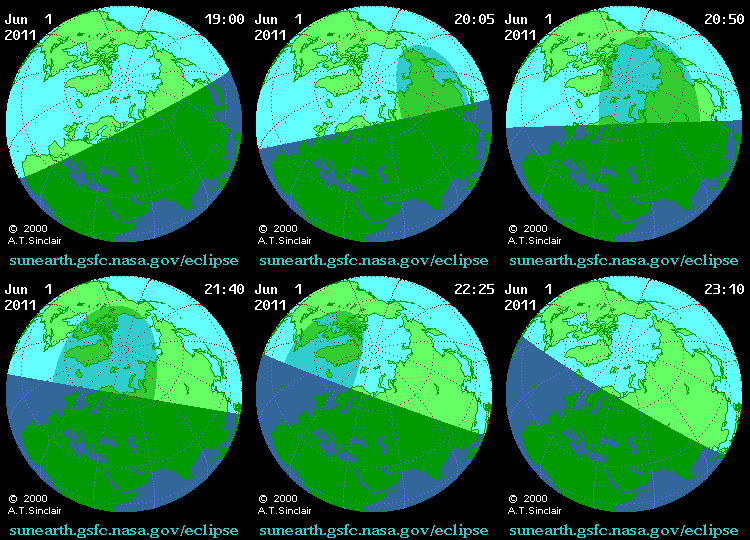
The Second Solar Eclipse of the four eclipses for the year shall be taking place on 1-2nd June 2011 when the Moon shall pass infront of Sun and Earth linear path with the Higher Northern Latitudes.
The Eclipse will begin from Asia as the sunrises in Siberia,Northern China by 19:25:18UT.
Northern China when the Penumbral-1 stage sets in


Areas in North Eastern China shall see the Eclipse during the Sunrise of 2nd June 2011 as the Sun rises in Eclipse phase only. The approximate sunrise for the location ChangChun is around 0400hrs Local Time,Harbin (0327am) LT ON 2ND JUNE 2011
Areas in North Korea- Around 0430AM LT on
2nd June 2011

THE MAXIMUM ECLIPSE SHALL BE DURING 21:17:18 UT,1ST JUNE 2011 OF MAGNITUDE 0.6 AND SHALL BE APPEARING MAXIMUM CLOSE TO THE NORTH POLE
THAT IS THE ARCTIC COAST AROUND 64.7N, 46.8E SAROS 118,GAMMA- 1.213.
Thus the Shadow will be crossing the International Date Line and so regions in North America will witness the eclipse on previous day i.e 1st June 2011
The Eclipse shall end in New Foundland
region by 23:06 UT ( 1st June 2011)

LOCAL TIMINGS CAN BE FOUND


Its a Midnight Solar Eclipse. During Spring, due to the apparent migration of Sun in Northern Hemisphere, areas in the Arctic Circle has 24hrs of Sunshine i.e Sun doesn't set for apx 6 months in the region.

** CHECK Local Weather in advance to plan Eclipse Viewing Prog***


Thursday, April 7, 2011

7.1 Magnitude earthquake offcoast of Honshu,Japan. TSUNAMI WARNING LIFTED


TSUNAMI WARNING FOR NE COAST OF JAPAN HAS BEEN LIFTED!
Tsunami Warning lifted off for Miyagi Pref and for
IWATE PREF.
FUKUSHIMA PREF. PACIFIC COAST OF AOMORI PREF.
IBARAKI PREF.
The above-mentioned Tsunami Warnings/Advisories have been cancelled.

- 0058 JST,8TH APRIL 2011


No one has forgotten the 11th March 2011 - 8.9M earthquake off coast of Honshu,Japan which triggered a massive Tsunami

No more comments on that event.

An earthquake 7.1M as per USGC has struck Japan again at 14:32:41UTC,7th April 2011 with the epicenter at 38.253°N, 141.640°E
The epicenter was located 49 km below the surface

It was 66km East of Sendai
330km NNE of Tokyo

In Tokyo, tremor were experienced for 1minute with shaking of buildings.
However in Ichinoseki, tremendous movements were felt which is at East coast of Japan


TSUNAMI WARNING FOR NE COAST OF JAPAN HAS BEEN LIFTED!
Tsunami Warning lifted off for Miyagi Pref and for
IWATE PREF.
FUKUSHIMA PREF. PACIFIC COAST OF AOMORI PREF.
IBARAKI PREF.
The above-mentioned Tsunami Warnings/Advisories have been cancelled.

- 0058 JST,8TH APRIL 2011


**
FUKUSHIMA DA-ICHI PLANT IS FUNCTIONING NORMALLY RIGHT NOW. NO NUCLEAR THREAT

PACIFIC TSUNAMI CENTER HAS NOT ISSUED ANY TSUNAMI WARNING AS THE DEPTH OF EARTHQUAKE IS LARGE.
** HOWEVER COASTAL TSUNAMI WAVES ARE LIKELY TO AFFECT EASTERN COAST OF JAPAN
** JAPAN METEOROLOGICAL AGENCY HAS ISSUED A LOCAL TSUNAMI WARNING

Statement by Japan Meteorological Agency-

sunami Warning/Advisory

Issued at 23:34 JST 07 Apr 2011

******************Headline******************
Tsunami Warnings (Tsunami) have been issued for the following coastal regions of Japan:
MIYAGI PREF.
Evacuate immediately to safe place away from the shore in the above coastal regions.
Tsunami advisories are currently in effect in other coastal regions of Japan.

*******************Text********************
Tsunami Warnings have been issued for the following coastal regions of Japan:

*MIYAGI PREF.
Evacuate immediately to safe place away from the shore in the above coastal regions.

Tsunami Advisories have been issued for the following coastal regions of Japan:

PACIFIC COAST OF AOMORI PREF.
*IWATE PREF.
FUKUSHIMA PREF.
IBARAKI PREF.

Tsunamis are expected to arrive imminently in the following coastal regions of Japan
(coastal regions shown above with * marks):
MIYAGI PREF.
IWATE PREF.

***********About Tsunami Forecast************

Tsunami height is expected to be up to 2 meters. Caution advised.

Tsunami height is expected to be about 0.5 meters. Attention advised.

******* Earthquake Information ********
Occurred at 23:32 JST 07 Apr 2011
Region name MIYAGI-KEN OKI
Latitude38.2N
Longitude142.0E
Depth about 40 km
Magnitude 7.4


RELATED USEFUL LINKS
http://www.jma.go.jp/en/tsunami/


STAY TUNED FOR UPDATES AT

http://www.facebook.com/pages/Severe-Solar-Weather-forecast/112556765473804