WELCOME!

WELCOME TO AKG!

FOR VIEWING SPACE WEATHER PRODUCTS CLICK HERE
AND THEN CLICK "ENTER"

-------------------------------OR-----------------------------------------
TO READ ARTICLES ON AKG BLOG OR SPACE WEATHER FORECASTS ( SEVERE SOLARWX) CLICK "ENTER" BELOW
ENTER

Saturday, March 10, 2012

Geomagnetic Storm dissipates,Minor Storm expected on 11th Mar 2012

SEVERE SOLARWX
Akshay Deoras
Severe Weather Forecaster

The anticipated storm of the year produced a classic G3 level Geomagnetic Storm which could have reached the G4 level but the IMF Bz was having Northerly Polarity for a prolonged time spoiling the momentum of CME impact.

The Geomagnetic Storm produced significant auroras in the United States also where people reported them from states like North Dakota,Wisconsin, Minnesota.

The Solar Radiation storm which hit the S3 level is declining and is now at S2 level which may be the Biggest Storm in perhaps last 5 years!


Estimates suggest that the Radiation Storm would be over in around next 24 hours!! 


The Sun Now!


The Sunspot 1429 is decaying now and having stable magnetic orientation. 
It seems that it may not be producing another X class flare however SWPC considers a slight chance. 
The sunspot is still capable of producing Moderate M class flares to low C class flares. 

The overall earth facing side of the Sun has a coronal hole on the extreme eastern side of the Sun from which a solar wind will be flowing when it turns geo-effective. 

There is one interesting sunspot rotating now on the North-eastern limb. This sunspot ( may be named as AR 1431) posses less threat now but may become favorable for producing high end C and even M class flare in the next week onwards..

Approaching CME 


As was mentioned in the previous post, the Solar Flare of March 9 produced a CME which is heading towards the Earth. The WSA-ENLIL model indicates the approaching CME towards the Earth ( seen as a green dot) from the sun ( yellow dot at center). 

The plasma density at the impact which will be around morning of 11th Mar 2012 GMT that is tomorrow shall be around 15/cm^3 with the Radial Velocity of around 700Km/sec. 
The overall momentum from the impact seems to be low at this level and will just sparkel a G1 Geomagnetic Storm. However as seen from the above Goddard Space Flight Center analysis, the IMF Bz polarity seems to be Northwards which will lead to a weak start to the storming and revive when much of CME would have passed. Hence SSW expects a weak G1 Geomagnetic Storm on 11th March and may expect on 12th but with less chance


Severe SolarWX to enter print media!

I am happy to announce that the Severe SolarWX will be making an entry in the print media with the first and exclusive Space Weather Forecasts coming in Newspapers in India. Not seen usually, for the first time people of my hometown Nagpur,India will get to read about the Space Weather events especially forecasts which will be issued in Marathi language. However I will be posting a link for the readers knowing Marathi language who can avail the forecasts through the E-paper 

The forecasts also will be coming in English on The Hitavada newspaper on Tuesdays ( when there is a space weather event) and in Tarun Bharat Paper ( Marathi) language. 

This service is expected to start from around 20th March 2012. 


STAY TUNED FOR UPDATES

Friday, March 9, 2012

G3 Geomagnetic Storming in progress,another CME heads towards the Earth

SEVERE SOLARWX
Akshay Deoras
Severe Weather Forecaster

The anticipated G3 Geomagnetic Storming is in full swing now with the Kp index at Kp=7. As was mentioned in the last post, favored Southward Bz helped the storming.


AURORAS ARE EXPECTED IN MID LATITUDE REGIONS OF BOTH THE HEMISPHERE AS WELL AS POLAR REGIONS. 


PEOPLE CAN SEND THEIR PHOTOS AT akshaydeoras@hotmail.com WHICH WILL BE POSTED ON THE BLOG WITH DUE CREDIT .


The Bz IMF is turning Northwards again and hence the G3 level may be the zenith of the event

Coronal Mass Ejection from AR 1429 on 9th March 2012

As mentioned in the last post, a strong M 6.3 Solar Flare was released from AR 1429 which hurled a Coronal Mass Ejection as seen from the animation captured by the STEREO spacecraft

THE CME IS HEADING TOWARDS THE EARTH! THE FORECAST MODELS ARE ESTIMATING ITS INTENSITY AND TIMINGS BUT MAY REACH THE EARTH ON 10-11TH MARCH 2012


MEANWHILE,THE SOLAR RADIATION STORM HAS DECREASED FROM S3 TO S2 LEVEL


STAY TUNED FOR UPDATES


Sunspot 1429 bangs with a M5 class Solar Flare

SEVERE SOLARWX
Akshay Deoras
Severe Weather Forecaster

The Hyper-active sunspot region AR 1429 has produced another M5 Solar Flare just a while ago and sent ionospheric disturbance due to X-ray emissions thus causing a R1 Radio Blackout


Stay tuned for updates


Akshay Deoras
Severe Earth & Space Weather Forecaster,Astrophysics article writer.

Web-
www.akshaydeoras.blogspot.com
www.metdweather.blogspot.com
        www.scribd.com/akshaydeoras


Thursday, March 8, 2012

IMF turning Southwards, Strong Geomagnetic Storming favored!

SEVERE SOLARWX
Akshay Deoras
Severe Weather Forecaster

The Strong Geomagnetic Impulse i.e CME striking the Earth didn't produce a much elevated storming as was expected as the Inter-planetary Magnetic Field (IMF) was at North polarity. A much of annihilation to the CME impact is caused by Northward IMF polarity which opposes the Geomagnetic Storming. However as the IMF's Bz vector turns southward, the surface North to South geomagnetic field of the earth and the opposite oriented IMF reconnects and transfer of energy takes place which enables pouring in of the solar wind,subsequent triggering of Auroras and Geomagnetic Storming. 

Since the total momentum of the impact was high, it can be expected that the ongoing G1 Geomagnetic Storm will elevate to G2 or even G3 depending on the total tenure for which IMF 's Bz vector trips South! 


As seen from the above ACE plot, the second plot from top ( represented in yellow) represents the Bz component of the IMF which when the CME impacted ( See for 11 GMT) elevated to the North! 

The Bz is now nearly 0 or turning Southwards which will improve overall Geomagnetic Activity

Stay tuned for alerts!


Akshay Deoras
Severe Earth & Space Weather Forecaster,Astrophysics article writer.

Web-
www.akshaydeoras.blogspot.com
www.metdweather.blogspot.com
        www.scribd.com/akshaydeoras

Strong Geomagnetic Sudden Impulse!! Strong CME hits ACE satellite

SEVERE SOLARWX
AKSHAY DEORAS
SEVERE WEATHER FORECASTER

One of the strongest Geomagnetic Sudden Impulse I have ever seen has just hit the ACE spacecraft ( CME hit) and the shockwave will hit the Earth's Magnetic Field very shortly ( about half hour from now)

The deviation produced is 37.7 nT and the Bz 35.6 nT north

The present IMF is in north and hence solar wind might not pour in now!!

We are monitoring the situation LIVE at Severe SolarWX Hq,Nagpur

SIGNIFICANT GEOMAGNETIC STORMING POSSIBLE DUE TO X 5.4 SOLAR FLARE

SEVERE SOLARWX
AKSHAY DEORAS
SEVERE WEATHER FORECASTER

HISTORIC GEOMAGNETIC STORMING LIKELY. ALERT FOR HYPER-ACTIVE SPACE WEATHER

The Mega Flare of X 5.4 from Sunspot 1429 on 7th March 2012 early period GMT has hurled a very massive Coronal Mass Ejection. In the last post,datas were suspicious about the amount of CME released and coupled with no animation available from SOHO lead to miscalculation. 

Right now it seems that a very major CME is heading towards the Earth. The analyst at Goddard Space Flight Center which also recalculated CME intensity indicate the approaching CME


Considering the intensity of the shockwave ( estimated) the Space Weather Prediction Center estimates a G3 Geomagnetic Storming which Severe Solar WX AGREES WITH IT

If the intensity is really too high then we may even get a G4 Geomagnetic Storm!

The Geomagnetic Sudden Impulse is being expected in the afternoon hours ( GMT) of today,8th March 2012 and the storming shall begin into night hours of today ( 8th March),persisting for tomorrow ( 9th March also)

THUS THIS GEOMAGNETIC STORMING IS GOING TO PROMISE AURORAS FOR MID LATITUDE REGIONS ALSO INCLUDING HIGH LATITUDE AREAS

PEOPLE MUST WATCH OUT FOR THEM!

SOLAR RADIATION STORM UPDATE-

The S3 Solar Radiation Storm is continuing now with more than 12hrs of S3 category. The Proton flux indicates that the the overall proton number per unit area unit time and unit steradian has enhanced to over 1000 protons ( 10^3+) 

The Solar Protons are expected to continue for today ( 8th March also)

Photos of Sunspot 1429

The sunspot 1429 which has become the star of attraction was captured by me today morning from Nagpur,India using an ordinary camera of 14.1 megapixel


STAY TUNED FOR UPDATES!!!

Wednesday, March 7, 2012

Solar Radiation Storm Reaches S3

SEVERE SOLARWX
AKSHAY DEORAS
SEVERE WEATHER FORECASTER

As was expected by me just a short while ago,the solar radiation storm has reached a classic S3 level.
The S3 level Radiation Storm has potential effect such as Biological Hazards like increased radiation exposure to people in high altitude and latitude aircrafts etc..

Stay tuned for updates

Hyperactivity on the Sun!

SEVERE SOLARWX
Akshay Deoras
Severe Weather Forecaster

The Hyper-active Sunspot 1429 has hurled another Very Major Solar Flare X 5.4 shortly after 12AM GMT,7th March 2012


The X5.4 Solar Flare emission took place beginning at 0002UTC reaching peak 0024UTC and ending at 0040UTC!


NOAA Space Weather Prediction Center also mentioned a X1.3 Solar Flare shortly after the X 5.4 at 0120UTC.Thus TWO STRAIGHT HIGH END SOLAR FLARES


The X-ray flux reported a sharp peak shortly after 12AM or 0000UTC.

After the solar flare got released, a R3 Radio Blackout was experienced on the sunlit side of the earth which affected largely the High frequency communication as can be seen from the above image of D-RAP

CORONAL MASS EJECTION- 
Its generally associated with such high class Solar Flares. The datas from STEREO spacecraft are indicating that there has been a MODERATE Coronal Mass Ejection released from this region after the Solar Flare was emitted. 


Though its for the first time in so many years that on Visual observation, it does appear that not a significant CME was hurled after the flare. Even the analyst at Goddard Space Flight Center predicting not a major CME release from it which supports my visual observation through datas for STEREO. 


Here is below what the models are indicating about-


The CME hence shall give a minor blow to the Earth on late period of 9th March 2012 into morning hours of 10th March 2012 GMT.. I don't expect a significant storming from it

Meanwhile, the reports from previous activities of the Sun have appeared today in the form of a G2 Geomagnetic Storm ( MODERATE) due to March 4 2012 M class flare from the sun with the KP index reaching as 6


SOLAR RADIATION STORM 


The X 5.4 Solar Flare from today's early morning flare also gave a significant boost to the protons which got elevated in terms of their energies and hence a Solar Radiation Storm of S2 intensity has been set. The datas from the Proton Flux are depicting an increasing trend and hence a high end S2 Solar Radiation Storm which is being witnessed now shall continue for a more while!


Forecast-


More X class and M class Solar Flares are expected from the region 1429 which is over 4 times the size of the earth. 


The space weather is expected to be ACTIVE mainly Solar Radiation Storm and Geomagnetic Storm 


ALERT_ 
Sunspot 1429 is turing GEO-EFFECTIVE AND HENCE IS LIKELY TO AFFECT THE EARTH's Space Weather significantly!


Monday, March 5, 2012

Sub surface Fault

Sub surface fault is a fault located beneath a surface, invisible to people above. While conventional fault is easily detectable by seeing difference in rock type, or displacement over placemarks like fence, road, or cracks at wall, sub surface fault is hard to detect. A subsurface fault might be a fault which is active, but its presence is covered by a layer of sediments / rock of same type - so any displacement made by the fault is 'seems to be invisible'. One way to detect a subsurface fault is by doing a research over seismic data; I mean, firstly we should have a data of earthquake occurence around our area of interest. Then we do a more comprehensive geophysical survey like raw seismic data processing with computer programs. Then we can correllate the result of data processing to the shape of fault and even how it's moving. Another try to know how is the subsurface fault looks like is by doing geoelectrical survey or seismic survey, but it's unlikely to be success if it done in / near a densely populated area.

Conventional fault, Bordeaux, France (wikipedia)

Subsurface fault in Iraq, near Tigris river. This fault is invisible to people above because it is covered with Tigris river's deposits. The corresponding geoelectrical pseudo-resistivity is shown below. These data are obtained after Nabeel Hameed Al Saigh in this paper. We could see that the densest contour is corresponding to change in rock type and thus it may be concluded that there is faulting activity there.

In the case of Haryana earthquake, I really have no idea how the fault is moving. But by seeing the geological map of India, the case seems like that of Tigris River: A subsurface fault covered by Yamuna river deposits has triggered 5.5 M earthquake. Video here, in NDTV (the earthquake movement is not obviously seen but people runs out). Unfortunately, there is no fault plane solution so I can't infer the fault movement. But from seismograph record here I might say that this sub surface fault would be a normal one. For reader, correct me if I'm wrong haha :-).


MODERATE EARTHQUAKE TREMORS FELT ACROSS NEW DELHI,NCR

A MODERATE EARTHQUAKE OF 5.2M ON RICHTER SCALE AS MEASURED BY USGC HAS OCCURRED AT 28.8N,76.7N 48KM WNW OF NEW DELHI

THE DEPTH OF THE EARTHQUAKE IS 19.1KM.

SHAKING WAS WIDELY EXPERIENCED IN NEW DELHI,NCR AND VICINITY HOWEVER PEOPLE FROM LUDHIANA,PUNJAB DIDN'T EXPERIENCE ANY.

MAGNITUDE

5.2
Date-Time
Monday, March 05, 2012 at 07:41:06 UTC
Monday, March 05, 2012 at 01:11:06 PM at epicenter
Location
28.808°N, 76.772°E
Depth
19.1 km (11.9 miles)
Region
HARYANA - DELHI REGION, INDIA
Distances
48 km (30 miles) WNW (296°) from NEW DELHI, Delhi, India
93 km (58 miles) WSW (257°) from Meerut, Uttar Pradesh, India
143 km (89 miles) N (7°) from Alwar, Rajasthan, India
Location Uncertainty
horizontal +/- 16.2 km (10.1 miles); depth +/- 6.7 km (4.2 miles)
Parameters
NST=109, Nph=111, Dmin=970.7 km, Rmss=1.16 sec, Gp= 58°,
M-type=body wave magnitude (Mb), Version=7
Source
Magnitude: USGS NEIC (WDCS-D)
Location: USGS NEIC (WDCS-D)
Event ID
usb0008bau


IN THE ABOVE IMAGES,
THE RED STAR IS THE EPICENTER OF THE EARTHQUAKE WHICH IS 19.78KM SE OF ROHTAK,HARYANA

IMD HAS REPORTED THE EARTHQUAKE TO BE 4.9 BUT AKG SEISMOLOGY TEAM CONSIDERS THE USGC PARAMETER

IF YOU HAVE ANY VIDEO/PHOTO OF DAMAGE

PLEASE SEND

akshaydeoras@hotmail.com

NO AFTERSHOCK EXPECTED

Radio Blackout affecting Sunlit side of the Earth

In response to the X class flare ( Intensity being estimated) by the Sunspot 1429,A former R3 now R2 Radio Blackout is affecting the sunlit side of the Earth
As seen from this image,the higher frequency signals are being largely attenuated due to the Radio Disturbance as the signals propogate through a disturbed ionosphere..

Mega Solar Flare from Sunspot 1429!!

SEVERE SOLARWX
AKSHAY DEORAS
SEVERE WEATHER FORECASTER

AFTER A BRIEF PERIOD OF QUIET SPACE WEATHER,OUR SUN IS WAKING UP DUE TO THE SUNSPOT AE 1429. The Sunspot is 4 times the size of the Earth.
The GOES X Ray flux is indicating a major Solar Flare in progress and a R3 Radio Blackout is in progress on the Sunlit side of the earth including here in India at the Higher Frequency

Solar disc is rotating and hence the sunspot 1429 will become geoeffective after some days... If it hurls another X class flare then that may be a source of big problem

Stay tuned as the event unfurls

Wednesday, February 29, 2012

Is the Sun really heading for Solar Maximum?

SEVERE SOLARWX
Akshay Deoras
Severe Weather Forecaster

With less than a year away from the forecasted Solar Maximum of Solar Cycle 24, the sunspot activity has flattened since the beginning of this year. The Sun which was hyper active in terms of its Sunspot Number ( Daily and monthly) is quiet these days with practically few weak ( Magnetically stable configuration). The datas from IPS Solar indicate that the Sunspot no. of January 2012 has been 58.3 as against the predicted 74.8 and 73.0 of December 2011. 

Just to remind that the Sunspot no. had reached a peak of 96.7 in Nov 2011 which was far higher than 67.7 predicted. 


Below- 
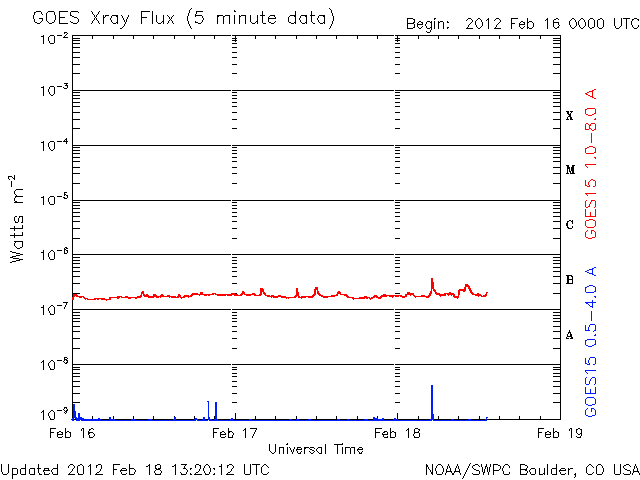
The GOES X ray flux between the period Feb 16-19 and Feb 27-present shows flattened X ray output of the sun. 
This scenario has been very common since this year! 


Seen below is a plot of Solar Activity Level during the period 30th Jan - 28th Feb 2012 indicating Solar Activity level flat at low or very low except for 06th Feb 2012. The below plot considers the overall Solar Flares and CME from the sun. 


These are just preliminary datas. I shall write in details around 17th March 2012 considering the new parameters


Akshay Deoras
Severe Earth & Space Weather Forecaster,Astrophysics article writer.

Web-
www.akshaydeoras.blogspot.com
www.metdweather.blogspot.com
        www.scribd.com/akshaydeoras


Tuesday, February 14, 2012

Static Instability

Alutsyah Luthfian | Create Your Badge

While seeing the weatherman said "It gonna be rain in Jakarta tomorrow", a critical person should think what mechanism driving the air to put down some of it moisture. He would run for YouTube, chasing the lapse rate videos showing the grow of cloud over time. Then he could also run for satellite images seeing the case of it. Then he would got a simple conclusion that the water vapor rises high to the sky and it cools down, and after that it rains. Then he asked again to himself, how a cloud could rise? Why not all cloud rising and pour rain? Then he may google it up and found articles talking about it. Some articles said that convective energy available in a specific area governs that. It may say that convective energy, is related to static instability.

Here, i just trying to talk about static instability. In meteorology, especially the one talking about weather phenomenon happening at the spatial scale of 2 - 2000 km (mesoscale), there are 5 types of instability: Static instability, Inertial instability, Shear instability, Symmetric instability, and Centrifugal instability. Each type of instability has their own use. The static instability is used to determine whether a place is potential for thunderstorm buildup or no. Even in tornadogenesis, static instability plays a great role in determining how powerful the tornado will be.

Formulation of Buoyancy


Let we consider a piece of air parcel trying to rise in the sky. The vector working at this air parcel is buoyancy B defined as these. \[\overrightarrow B = \overrightarrow g \cdot \frac{{\left( {T - \overline T } \right)}}{{\overline T }}\] For sure, because of buoyancy, the parcel of air is rising. Let's see that Newton's Law stated a force has acceleration, so then we can infer that the buoyancy force accelerates the air parcel upward against gravitational force, $\overrightarrow B = \frac{{d\overrightarrow w }}{{dt}}$, $\overrightarrow w$ is upward velocity. We also know that the upward velocity $\overrightarrow w = \frac{{d\overrightarrow {\Delta z} }}{{dt}}$ for ${\overrightarrow {\Delta z} }$ is displacement along the troposphere's depth. Then, we could describe the buoyancy force in more intricating form like these. \[\frac{{{d^2}\overrightarrow {\Delta z} }}{{d{t^2}}} = g \cdot \frac{{\left( {T - \overline T } \right)}}{{\overline T }}\] Now its the time to talk about the two kinds of T in equation above. The $T$ stands for air parcel temperature and the $\overline T $ stands for environmental temperature.

Breaking Apart the $T$ and $\overline T $


In meteorology, the $T$ and $\overline T $ are actually changing with height. We usually says that temperature decreases with height, but let us change that view: in case of air inversion caused when hot air is advected to a cooler region, air aloft is warmer than that of surface, so we better describe temperature as a continuous function of z; $T\left( z \right)$ and $\overline T \left( z \right)$. Then, if we fly from height z0 to height a in troposphere,
  1. \[T\left( a \right) - T\left( z_0 \right) = \int\limits_{{z_0}}^a {T'\left( z \right)dz} \]
  2. \[\overline T \left( a \right) - \overline T \left( z_0 \right) = \int\limits_{{z_0}}^a {\overline T '\left( z \right)dz} \]
Analyzing the integral like a sir: $\int {UdV} = UV - \int {VdU} $. We define $U = T'\left( z_0 \right)$ or that $ \Rightarrow$ $U = \overline T '\left( z_0 \right)$, and $V = - (a - z)$ so that $dV = dz$, then equation (1.) and (2.) looks like these.
  1. \[T\left( a \right) - T\left( {{z_0}} \right) = T'\left( z_0 \right)\left( {a - {z_0}} \right) + \int\limits_{{z_0}}^a {\left( {a - z} \right)T''\left( z \right)dz} \]
  2. \[\overline T \left( a \right) - \overline T \left( {{z_0}} \right) = \overline T '\left( z_0 \right)\left( {a - z_0} \right) + \int\limits_{{z_0}}^a {\left( {a - {z}} \right)\overline T ''\left( z \right)dz} \]
You can analyze the integration above further, and you may found that it is never end. A note when doing integration above is treating $V = (a - z)$ just like $V = - ({z^ * })$ , as we know that whenever we add or substract the domain z, it still located at the z-line but with another quantity. If you forgot to treat $V = (a - z)$ as $V = - ({z^ * })$, the integration result will be different with below.
  1. Temperature of air parcel at height a
    \[T\left( a \right) = T\left( {{z_0}} \right) + T'\left( {{z_0}} \right)\left( {a - {z_0}} \right) + ... + \frac{{{T^n}\left( {{z_0}} \right)}}{{n!}}{\left( {a - {z_0}} \right)^n}\]
  2. Temperature of environment at height a
    \[\overline T \left( a \right) = \overline T \left( {{z_0}} \right) + \overline T '\left( {{z_0}} \right)\left( {a - {z_0}} \right) + ... + \frac{{{{\overline T }^n}\left( {{z_0}} \right)}}{{n!}}{\left( {a - {z_0}} \right)^n}\]
To simplify, we can ignore the small figures of $\frac{{{T^n}\left( {{z_0}} \right)}}{{n!}}{\left( {a - {z_0}} \right)^n}$ and $\frac{{{{\overline T }^n}\left( {{z_0}} \right)}}{{n!}}{\left( {a - {z_0}} \right)^n}$ so that the equations above are limited to the second figure. Defining
${\Gamma _p} = T'\left( z_0 \right) \to \frac{{\partial T}}{{\partial z}}$, the change of air parcel temperature with the change of height and
$\gamma = \overline {T} '\left( {z_0} \right) \to \frac{{\partial \overline T }}{{\partial z}}$, the change of environmental air temperature as the height changes, so $T$ and $\overline T $ equals to:
  1. \[T = {T_0} + {\Gamma _p}\left( {\Delta z} \right)\]
  2. \[\overline T = {\overline T _0} + \gamma \left( {\Delta z} \right)\]
$T$ is parcel temperature at height a, ${T_0}$ is parcel temperature at height ${z_0}$, ${\Delta z} = a - {z_0}$, $\overline T$ is environmental temperature at height a, ${\overline T _0}$ is environmental temperature at height ${z_0}$.
The first state of air parcel in atmosphere is always equilibrum, means that air parcel temperature is the same with environmental temperature (${T_0} = {\overline T _0}$), so that equation (7.) and (8.) finally become:
  1. \[T = {T_0} + {\Gamma _p}\left( {\Delta z} \right)\]
  2. \[\overline T = {T _0} + \gamma \left( {\Delta z} \right)\]

Stability of Environmental Lapse Rate


Reviewing the equation for $\overrightarrow B$, let us analyze it in depth.
  1. \[\overrightarrow B = \overrightarrow g \cdot \frac{{\left( {T - \overline T } \right)}}{{\overline T }}\]
Then we replace the $T$ and $\overline T$ with ones from equation (9.) and (10.).
  1. \[\frac{{{d^2}\overrightarrow {\Delta z} }}{{d{t^2}}} = \overrightarrow g \frac{{\left( {{T_0} - {\Gamma _p} \cdot \Delta z - {T_0} + \gamma \cdot \Delta z} \right)}}{{{T_0} - \gamma \cdot \Delta z}}\]
  2. \[\frac{{{d^2}\overrightarrow {\Delta z} }}{{d{t^2}}} = - \overrightarrow g \Delta z\frac{{\left( {{\Gamma _p} - \gamma } \right)}}{{{T_0} - \gamma \cdot \Delta z}}\]
If the ${\Delta z}$ is small, then the ${\gamma \cdot \Delta z}$ is very small compared to ${T_0}$ so it is possible for us to ignore ${\gamma \cdot \Delta z}$. After that, the equation (13.) becomes this.
  1. \[\frac{{{d^2}\overrightarrow {\Delta z} }}{{d{t^2}}} + \overrightarrow g \Delta x\frac{{\left( {{\Gamma _p} - \gamma } \right)}}{{{T_0}}} = 0\]
The equation (14.) above is a form of second order ordinary differential equation. Some people likes to use the term linear instead of ordinary but this is just a matter of convenience. For brevity, you can click here if you wanna know much about theorems and solving the second order ordinary differential equation. The main point is the equation (14.) has the solution as presented below.
  1. \[\Delta z\left( t \right) = {C_1} \cdot {e^{i{{\left[ {{\textstyle{g \over {{T_0}}}}\left( {{\Gamma _p} - \gamma } \right)} \right]}^{\frac{1}{2}}}t}} + {C_2} \cdot {e^{ - i{{\left[ {{\textstyle{g \over {{T_0}}}}\left( {{\Gamma _p} - \gamma } \right)} \right]}^{\frac{1}{2}}}t}}\]
    $C_1$ and $C_2$ is a constant depending on the magnitude and direction of initial parcel displacement. We don't use vector here because we emphasize the quantity of the vector as a function of time.
If ${\Gamma _p}>{\gamma }$, the equation (15.) preserves its form. To know the characteristics of equation (15.) we should convert the exponentials into a complex function, based from ${e^{i\left( \theta \right)}} = \cos \left( \theta \right) + i \cdot \sin \left( \theta \right)$, as invented by Euler via Maclaurin series expansion. Then, we just consider the real part of ${e^{i\left( \theta \right)}}$, that is $\cos \left( \theta \right)$ (because we can't see imaginary waves! ).
After changing the equation (15.) into complex form and taking just the real part, then we obtain this very (16.) equation.
  1. \[\Delta z\left( t \right) = \left( {{C_1} + {C_2}} \right) \cdot \cos \left\{ {{{\left[ {{\textstyle{g \over {{T_0}}}}\left( {{\Gamma _p} - \gamma } \right)} \right]}^{{\textstyle{1 \over 2}}}}t} \right\}\]
Seeing the equation (16.) above, reminds us about common wave formula, the $\left( {{C_1} + {C_2}} \right)$ is the amplitude, and ${{{\left[ {{\textstyle{g \over {{T_0}}}}\left( {{\Gamma _p} - \gamma } \right)} \right]}^{{\textstyle{1 \over 2}}}}}$ is angular frequency of parcel motion, namely Brunt–Väisälä frequency. This means, when parcel lapse rate is bigger than environmental lapse rate, the air parcel would fail to rise. Instead of rising, the air parcel will trigger a gravity wave that propagates away from the location of displacement. The distortion seen above car's body in a very hot summer is a good approximation. Another approximation is the lines of altocumulus cloud form at afternoon after a stable day.
If ${\Gamma _p}<{\gamma }$, then $i{\left[ {{\textstyle{g \over {{T_0}}}}\left( {{\Gamma _p} - \gamma } \right)} \right]^{{\textstyle{1 \over 2}}}}$ becomes real. When the t is very big, the C1 can be ignored, and the equation would be like this.
  1. \[\Delta z\left( t \right) = {C_2}{e^{{{\left[ {{\textstyle{g \over {{T_0}}}}\left( {\gamma - {\Gamma _p}} \right)} \right]}^{{\textstyle{1 \over 2}}}}t}}\]
From equation (17.) above, it is obvious that when parcel lapse rate is smaller than environmental lapse rate, the air parcel would rise as the time going. The rising air parcel will release its heat and condenses into cloud and rain as it cools.

Convective Available Potential Energy (CAPE)


From the buoyancy equation above, an air parcel can only rise automatically if the temperature of air parcel is warmer than the environmental temperature. The level where the air parcel becomes warmer than the environmental temperature is called Level of Free Convection or LFC. Other point important in determining CAPE is equilibrum level, is when the air parcel temperature cools down to be the same with environmental temperature again.

This is the skew-T log-P plot showing CAPE, level of free convection, and equilibrum level.

Deriving CAPE:
  1. \[\frac{{d\overrightarrow w }}{{dt}} = \overrightarrow B \]
  2. Multiplying (18.) with $\overrightarrow w \equiv \frac{{d\overrightarrow z }}{{dt}}$
    \[\overrightarrow w \frac{{d\overrightarrow w }}{{dt}} = \overrightarrow B \frac{{d\overrightarrow z }}{{dt}}\]
  3. \[\frac{d}{{dt}}\left( {\frac{{{{\overrightarrow w }^2}}}{2}} \right) = \overrightarrow B \frac{{d\overrightarrow z }}{{dt}}\]
  4. Canceling the $dt$, and integrating (20.) from LFC from EL.
    \[\int\limits_{LFC}^{EL} {d{{\overrightarrow w }^2}} = 2\int\limits_{LFC}^{EL} {\overrightarrow B \cdot d\overrightarrow z } \]
  5. Vector dot product is scalar. So then,
    \[w_{EL}^2 - w_{LFC}^2 = 2\left[ {CAPE} \right]\]
  6. Since the vertical velocity $w$ at level of free convection equals 0, so vertical velocity at equilibrum level is considered maximum. Then,
    \[w_{EL}^2 = 2\left[ {CAPE} \right]\]
  7. \[\frac{1}{2} \cdot w_{EL}^2 = CAPE\]


Putting All Above Together


What drive cloud to pour rain? It is instability. Instability is driven by difference between air parcel temperature and environmental temperature. The more moisture an air parcel has, its lapse rate would be smaller (remember that water vapor is a good heat storage). Also, sky above a suburb or city is normally has bigger lapse rate compared to a field or forest. Steep lapse rate also experienced in frontal boundary. In mountains, the environmental lapse rate experienced there is a mix between horizontal and vertical environmental lapse rate, and that two are always big there. Big lapse rate of environment added with small lapse rate of air parcel would make the air parcel rise. The rising air parcel cools into water dropplet or ice (if the buoyancy is great), graupel or snow (if buoyancy is just positive). A tremendous buoyancy will turn the air parcels into a tremendous castle of cumulonimbus cloud - that's why forecasters uses CAPE as a parameter for determining thunderstorm. Buoyancy can even tilt a horizontally aligned rotational motion of air into an EF-5 wedge tornado. The buoyancy of air parcel in sea is relatively smaller than that of land (except in equator where the air parcel is forcedly lifted), because the environmental lapse rate is small, and so does the parcel lapse rate. In desert, the air parcel is mostly dry, so its lapse rate is big, along with the environmental lapse rate. What about hurricane forming in the sea? It is the case of shear instability, that later turned on the static instability and moreover, the inertial instability. Not all cloud pouring rain, because:
  1. Clouds have different rate of inner instability depending on their origin. The most unstable one will perform convection and possible to pour rain.
  2. The environmental lapse rate should be adequate to fire convection if no cloud is sufficiently unstable.

Wednesday, February 8, 2012

Prime numbers

Prime numbers are infintely many. But the chances of finding it when we count on very large figures, approaches zero - but it will never be zero probability in finding prime numbers. Just like addition of 1/2 + 1/3 + 1/4 + ..., the figure of 1/n approaches zero, but its sum is infinite. :-)

-ALUTSYAH LUTHFIAN-

Tuesday, January 24, 2012

Geomagnetic Sudden Impulse! CME arrives earlier than SSW forecast

SEVERE SOLARWX
AKSHAY DEORAS
SEVERE WEATHER FORECASTER

THE CME FROM THE JAN 23RD SOLAR FLARE HAS ARRIVED AND HAS CAUSED A GEOMAGNETIC SUDDEN IMPULSE.
STAY TUNED FOR MORE UPDATES!


Akshay Deoras
www.akshaydeoras.blogspot.com
www.metdweather.blogspot.com

Major Geomagnetic Storming expected due to CME of M9 class flare

SEVERE SOLARWX
Akshay Deoras
Severe Weather Forecaster

A MAJOR GEOMAGNETIC STORMING IS LIKELY FROM TONIGHT ( GMT) OVER 25TH JAN 2012


The Mega-flare of January 23rd, which released massive and very very fast moving CME towards the Earth is expected to cause a Major Geomagnetic Storming. Initial estimates from the Goddard Space Flight Center confirm that the CME speed was over 2200km/sec when released !

The arriving models are confirming that the CME is Earth-directed and likely to hit the Earth's Magnetic Field on night hours of 24th Jan 2012 today ( GMT).

As the momentum of CME is very high, it will definitely give a very strong hit to the Earth's magnetic field which definitely will trigger Major Geomagnetic Storm

The estimates are suggesting that the Geomagnetic Storming level can reach upto G3 level which the Space Weather Prediction Center of NOAA also suggests.

Attached below is the model which shows the approaching CME


Below model image shows CME just before the impact-


Highlights-


A VERY STRONG CME IS HEADING TOWARDS THE EARTH AND WILL HIT THE EARTH'S MAGNETIC FIELD ON NIGHT HOURS ( GMT) OF 24TH JAN 2012


* A MODERATE TO STRONG GEOMAGNETIC STORM UPTO G3 LEVEL IS EXPECTED DUE TO IT


* THE MEGA FLARE ALSO BOOSTED SOLAR PROTONS WHICH HAS CAUSED A S3 LEVEL SOLAR RADIATION STORM WHICH LAST HAPPENED IN 2005. 


* THE FLIGHTS TRAVELLING IN POLAR ORBIT ( POLAR ROUTE) WERE EXPECTED TO MAKE A PATH CHANGE TO AVOID EXPOSURE TO RADIATION!


* THE CME WILL SPARKLE AURORAS IN HIGH LATITUDE AND LIKELY IN LOW LATITUDE AREAS ALSO. 


STAY TUNED FOR UPDATES @ 


http://www.facebook.com/pages/Severe-Solar-Weather-forecast/112556765473804


Monday, January 23, 2012

M9 Class Solar Flare with CME released towards the Earth

A Major Solar Flare ( M9+) is in progress and has caused a Radio Blackout R2

monitor the situation LIVE

HERE

Update- 
0520hrs UTC,23rd Jan 2012


The Solar Flare has been recorded as an M9 or the last level of the M class flare! Coronal Mass Ejection has taken place which is heading towards the earth due to the geo-effective position. The source of this Solar flare seems to be the region AR 1402 and not the AR 1401


STAY TUNED FOR UPDATES

Saturday, January 21, 2012

Moderate Geomagnetic Storming possible ahead of CME release from M3 Solar Flare

SEVERE SOLARWX
Akshay Deoras
Severe Weather Forecaster

The nearly quiet space weather has activated after a brief gap considering the 1-Month ( Dec 2011) avg sunspot number to be less ( decreased value) after Nov 2011 as per Solar IPS.The observed no is 73.0 as against the predicted of ~ 72 for Dec 2011

More over, the Sunspot no of Nov 2011 was as high as 96.7 as against the predicted ~ 69 

With this, the sunspot no. has decreased from its previous month after June 2011. 

However the Sunspot region 1401 produced a Strong M3 class Solar Flare yesterday,19th Jan 2012 at around 1515-1630hrs UT
The Solar Flare caused R1 Radio Blackout  ( associated with X ray emission of the Solar Flare) reached the earth and impacted the Ionosphere

Have a look at the STEREO image of the CME release here

The CME is an Earth-directed one which has been confirmed through the model guidance. It does appear that the CME will hit the Earth's magnetic field sometime around early morning hours of Jan 22nd 2012 ( UTC ). The intensity is being monitored closely and I shall update later on it due to shortage of time now. 

However I do expect a Moderate Geomagnetic Storming ( G=2) around with plenty of Auroras reserved for the high latitude areas. 

Solar Weather Forecast-

I w'd like to discuss two aspects I am observing now from the Solar Dynamic Observatory images of Sun. 

1] As seen from the above imagery of magnetic lines, it does appear that Sunspot 1401 ( Visible as lower part of the two giant whitish region in North-Central part of sun) has symmetric magnetic field. 
As per the paper of SSW, sunspots having symmetric magnetic field posses energy for high end solar flares. 

I expect this sunspot to hurl some more high end M class flares to minor X ray flares in the coming days which are likely going to be earth-directed! 

Secondly, 
There appears a very large and marked Coronal Loop of the Sunspot 1402 just above the sunspot 1401. The coronal loops are those structures which extend in the  Solar Corona and anchored below the chromosphere in Solar Transition Region. Its a belief that in these coronal loops, there are ongoing heat transfer in them with the associated magnetic field. 

Some reports claim that when such coronal loops break, CME happen releasing tons of solar wind in the space. It will be an opportunity to study how there coronal loops behave at this time. 

Stay tuned for the updates!

Saturday, December 10, 2011


STAY TUNED FOR UPDATES AT

http://www.facebook.com/pages/Severe-Solar-Weather-forecast/112556765473804